
Pregnancy hCG Levels by Week: Chart, Normal Ranges, and What They Mean
-
 Amanda
 - Posted on
- 0 comments

Getting your first blood test during pregnancy can feel like reading a foreign language. Numbers, ranges, and medical terms. Right in the middle of it all is hCG. If you want to actually understand those results, learning about pregnancy hCG levels by week is a solid place to start.
What Is hCG?
hCG stands for human chorionic gonadotropin. Your body only produces this hormone during pregnancy. Once a fertilized egg implants in the uterine wall, usually 6 to 10 days after conception, the placenta begins releasing hCG into your bloodstream.
This hormone keeps progesterone levels high, which stops your uterine lining from shedding. Think of it as the body’s internal signal that a pregnancy has started and needs support.
Why Doctors Monitor hCG Levels
Doctors check hCG for more than just confirming a positive result. A blood test picks up pregnancy earlier and with more precision than any home test. Beyond that, drawing blood more than once over a few days (called serial testing) shows whether the pregnancy is developing on track.
If levels plateau or drop when they should be climbing, that is worth investigating. hCG also helps estimate gestational age when your period dates are uncertain. In some situations, unusual results point toward complications that need follow-up, including ectopic pregnancy.
Pregnancy hCG Levels by Week Chart
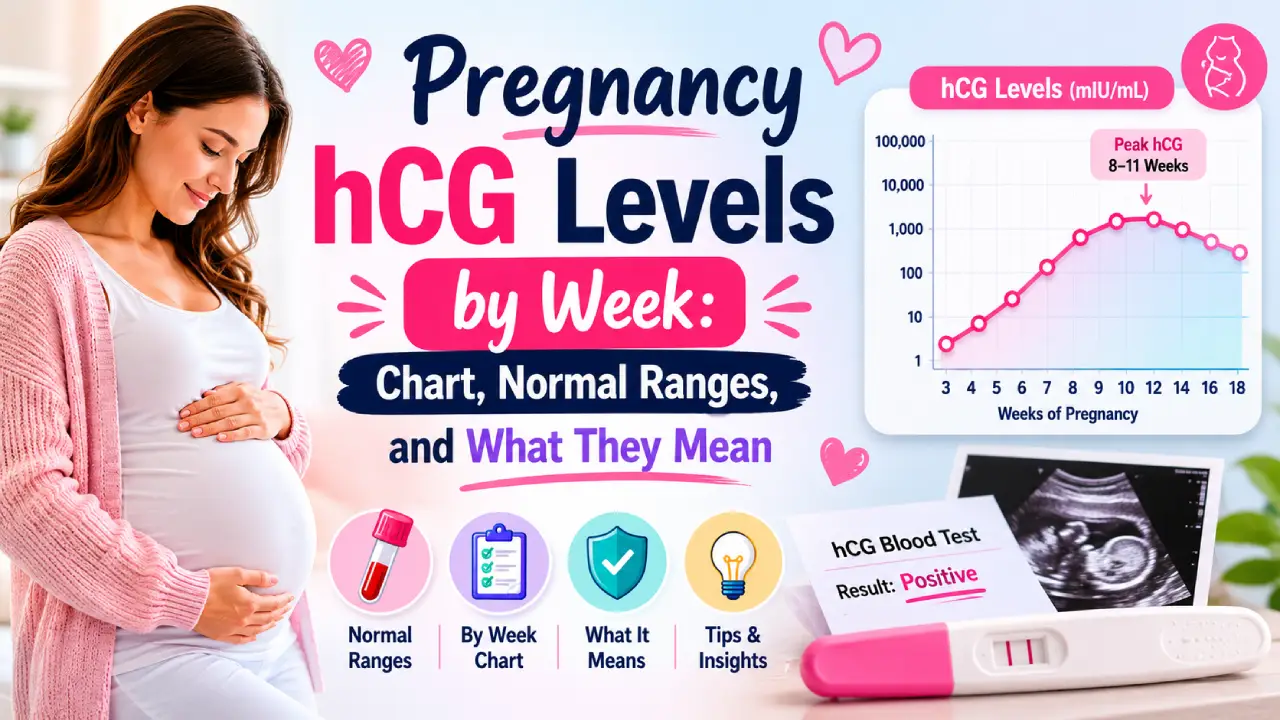
The table below shows typical hCG ranges at each stage. These are general reference points. A healthy pregnancy can land anywhere within these ranges, and sometimes slightly outside of them.
| Pregnancy Week | Typical hCG Range (mIU/mL) |
|---|---|
| 3 Weeks | 5 to 50 |
| 4 Weeks | 5 to 426 |
| 5 Weeks | 18 to 7,340 |
| 6 Weeks | 1,080 to 56,500 |
| 7 to 8 Weeks | 7,650 to 229,000 |
| 9 to 12 Weeks | 25,700 to 288,000 |
| 13 to 16 Weeks | 13,300 to 254,000 |
| 17 to 24 Weeks | 4,060 to 165,400 |
| 25 to 40 Weeks | 3,640 to 117,000 |
Take week 6 as an example. A result of 1,080 mIU/mL and a result of 56,500 mIU/mL both fall inside the normal range. That is a massive gap, and both are considered fine. This is why fixating on a single number rarely helps. Every pregnancy is genuinely different, and different labs may also use slightly different reference values.
Pregnancy hCG Levels at 2 Weeks
A lot of confusion starts here. When a doctor says you are 2 weeks pregnant, they count from the first day of your last period, not from conception.
Using that timeline, most people have not yet conceived at 2 weeks. Ovulation typically happens around day 14, and implantation follows several days after that. So asking about pregnancy hCG levels at 2 weeks is really asking about a point before hCG even starts forming. A negative test this early is expected, not alarming.
Pregnancy Test Level of hCG Detection
How high does hCG actually need to be for a test to turn positive?
Home urine tests typically detect hCG around 20 to 25 mIU/mL. Some sensitive brands advertise detection as low as 6 mIU/mL, though results can vary even within the same brand.
Blood tests are a different level of precision. A quantitative beta-hCG blood test can detect pregnancy at just 1 to 2 mIU/mL, making it far more sensitive than any drugstore option.
The pregnancy test level of hCG detection matters most when testing early. A few things affect your result:
- Morning urine is more concentrated, which makes early positives easier to catch.
- Testing before a missed period raises the risk of a false negative.
- Reading a urine test after the time window has passed can produce misleading evaporation lines.
- Different brands have different sensitivity levels.
How Fast Should hCG Levels Rise?
In early pregnancy, hCG typically doubles every 48 to 72 hours. After week 6, the doubling time stretches to every 72 to 96 hours, which is still normal.
Once levels pass around 1,200 mIU/mL, the rise naturally slows. By the end of the first trimester, a small dip is actually expected. Many people are surprised by this, but it is not a warning sign.
Slower doubling can sometimes point to:
- A pregnancy that is earlier than the dates suggest
- An ectopic pregnancy, where the embryo implanted outside the uterus
- A pregnancy that is not developing normally
Very high or fast-rising levels sometimes indicate twins, a miscalculated due date, or rarely, a molar pregnancy.
High hCG Levels During Pregnancy
Elevated results usually have a simple explanation. Twins or higher-order multiples produce more hCG because there is more placental tissue. A pregnancy further along than the dates show will also read higher. Some people just run on the higher end naturally with no issues at all.
Occasionally, very elevated levels point to a molar pregnancy. This is rare, and providers follow up with an ultrasound rather than relying on the number alone.
Low hCG Levels During Pregnancy
Low hCG is stressful to hear about, but it does not automatically mean bad news. The most common reason is a dating issue. If your cycle is irregular or you ovulated later than usual, your pregnancy is likely younger than the calendar assumes.
Other possibilities include a pregnancy that is not progressing, an early miscarriage, or an ectopic pregnancy where hCG tends to rise more slowly. Ectopic pregnancies are a medical emergency when confirmed.
One low reading is never the whole story. Repeat testing 48 hours later gives a much clearer picture.
Signs That hCG Is Progressing Normally
Rather than focusing on one number, look at the overall picture:
- Levels rising consistently from one draw to the next
- Doubling happening within expected timeframes
- Ultrasound matching gestational age once hCG passes roughly 1,500 to 2,000 mIU/mL
- Physical symptoms like nausea or fatigue, though these vary a lot
- No heavy bleeding or pelvic pain
When to Contact Your Healthcare Provider
Call your doctor or midwife if you notice:
- Heavy bleeding (light spotting can be normal, but heavier flow is not)
- Sharp or one-sided pelvic or abdominal pain, which may signal an ectopic pregnancy
- hCG dropping on repeat testing
- Pregnancy symptoms disappearing suddenly when something feels off
Online forums are not equipped to interpret your specific lab results. Your provider has the full clinical picture needed to give you a real answer.
Misoprostol Next-Day Delivery USA: Reliable Access to Women’s Healthcare Information
Access to accurate reproductive healthcare information is essential for women making informed decisions about their health.
Many individuals search online for topics related to pregnancy, miscarriage management, and medication options. Terms such as Misoprostol next-day delivery usa often reflect the need for timely information and healthcare access.
Likewise, people researching options may encounter searches such as Buy Misoprostol 200 mcg online. While information about medications is widely available, any medication used during pregnancy or reproductive healthcare should be discussed with a qualified healthcare provider.
Medical supervision helps ensure that treatment decisions are based on individual health needs, medical history, and current clinical guidelines.
Frequently Asked Questions
1. What are normal pregnancy hCG levels by week?
Normal ranges shift a lot throughout pregnancy. At 3 weeks, typical values fall between 5 and 50 mIU/mL. By weeks 9 through 12, levels can reach 288,000 mIU/mL. The ranges are wide because individual variation is significant. How levels trend over time matters far more than any single reading.
2. What are pregnancy hCG levels at 2 weeks?
At 2 weeks gestational age, most people have not yet conceived or are just ovulating. hCG is typically undetectable at this point. The hormone only begins rising after implantation, which happens around days 6 to 10 post-ovulation, placing it closer to weeks 3 to 4 in standard pregnancy dating.
3. What is the pregnancy test level of hCG detection?
Home urine tests generally detect hCG between 20 and 25 mIU/mL, though some brands go as low as 6 mIU/mL. Blood tests are more sensitive and can confirm pregnancy at 1 to 2 mIU/mL. Testing before implantation is complete can return a false negative even with a sensitive test.
4. How often should hCG levels double?
Early in pregnancy, hCG doubles every 48 to 72 hours. Once levels exceed 1,200 mIU/mL, that slows to every 72 to 96 hours. Levels then plateau and slightly decline in the second trimester, which is completely normal. Serial blood draws taken 48 hours apart are the standard way to check this pattern.
5. Can low hCG levels result in a healthy pregnancy?
Yes. Plenty of women carry healthy pregnancies with levels on the lower end. A dating error, where ovulation happened later than assumed, explains many seemingly low results. Levels that keep dropping or stay flat are more concerning and should be evaluated, but one low reading is not a diagnosis.
6. What causes high hCG levels?
Multiple pregnancies are the most common reason, since more placental tissue produces more hCG. A pregnancy further along than originally dated will also show higher numbers. In rare cases, very elevated levels point to a molar pregnancy. Providers order an ultrasound to investigate before drawing conclusions.
7. When do hCG levels peak during pregnancy?
hCG typically peaks between weeks 10 and 12. After that, levels come down and stabilize into the second trimester. A declining number during this window is expected, not a warning sign.
8. Should I worry if my hCG level is different from the chart?
Not automatically. Charts reflect population-wide ranges, not individual targets. One result outside those ranges means little without context. If your levels are rising consistently, your ultrasound matches your gestational age, and you have no concerning symptoms, there is usually no reason to panic. Bring specific concerns to your provider.
Conclusion
Understanding pregnancy hCG levels by week helps you make sense of early blood work without spiraling over a single number. One result on one day rarely tells the complete story. What matters is the pattern over time and how your specific results fit your clinical picture.
If something in your results is confusing or worrying you, your doctor or midwife is the right person to ask. They have the context that a chart simply cannot provide.
Medical Disclaimer:
This article is for informational purposes only and does not substitute for professional medical advice, diagnosis, or treatment. Always consult a qualified healthcare provider with questions about your pregnancy.