
Women’s Reproductive Health: A Guide to Early Pregnancy Signs
-
 Amanda
 - Posted on
- 0 comments

Your body talks to you constantly, but it doesn’t always speak clearly. One month your cycle runs like clockwork, the next you’re staring at a calendar wondering if that tender feeling in your chest means something or nothing at all. This is where a working knowledge of Women’s Reproductive Health actually pays off. It won’t hand you certainty, but it gives you the context to ask better questions and notice when something’s worth a closer look, especially when early pregnancy symptoms and ordinary PMS start blending together.
Below is a practical rundown of how the reproductive system works, what tends to go wrong with it, and how to read the earliest signs your body might be sending.
What Is Women’s Reproductive Health?
People often shrink this term down to “getting pregnant or not,” but it covers a lot more ground than that. Reproductive Health for Women spans the entire span of life from puberty onward, and it typically touches on things like:
- How regular (or irregular) your periods are
- Fertility, whether you’re trying to conceive or actively avoiding it
- Pregnancy itself, and the wellbeing that surrounds it
- Contraception options and access to them
- Sexual health more broadly
- Catching and treating reproductive conditions early
- Whether you can actually get care when you need it
That last point matters more than people realize. Knowing what “normal” looks like for your own body is only half the equation; having somewhere to turn when something feels off is the other half.
Understanding the Women’s Reproductive Health
It helps to know the basic map before you try to read any of the signals. Female Reproductive System Health hinges on a handful of parts that all work in tandem:
- Ovaries, which store eggs and pump out hormones like estrogen and progesterone
- Fallopian tubes, the passageway an egg travels through, and often where fertilization happens
- Uterus, the place a fertilized egg settles in and a pregnancy takes shape
- Cervix, the narrow connector between the uterus and vagina
- Vagina, linking the internal system to the outside
- The menstrual cycle and ovulation, the monthly hormonal rhythm behind all of it
When one piece of this system is thrown off by an underlying condition, it tends to show up in your period, your fertility, or how strongly (or faintly) you feel early pregnancy symptoms.
Common Women’s Reproductive Health Issues
Nearly everyone runs into some kind of reproductive health hiccup eventually, and most of them are treatable once identified. Some of the more frequent Women’s reproductive health issues include:
- Irregular periods
- Painful periods, sometimes labeled dysmenorrhea
- Heavy menstrual bleeding
- Polycystic ovary syndrome, or PCOS
- Endometriosis
- Uterine fibroids
- Vaginal infections
- Sexually transmitted infections
- Difficulty conceiving
A lot of these overlap in how they feel day to day, which is exactly why guessing from symptoms alone rarely gets you a real answer. A proper exam or test from a provider does the heavy lifting that self-diagnosis can’t.
Early Pregnancy Signs to Know
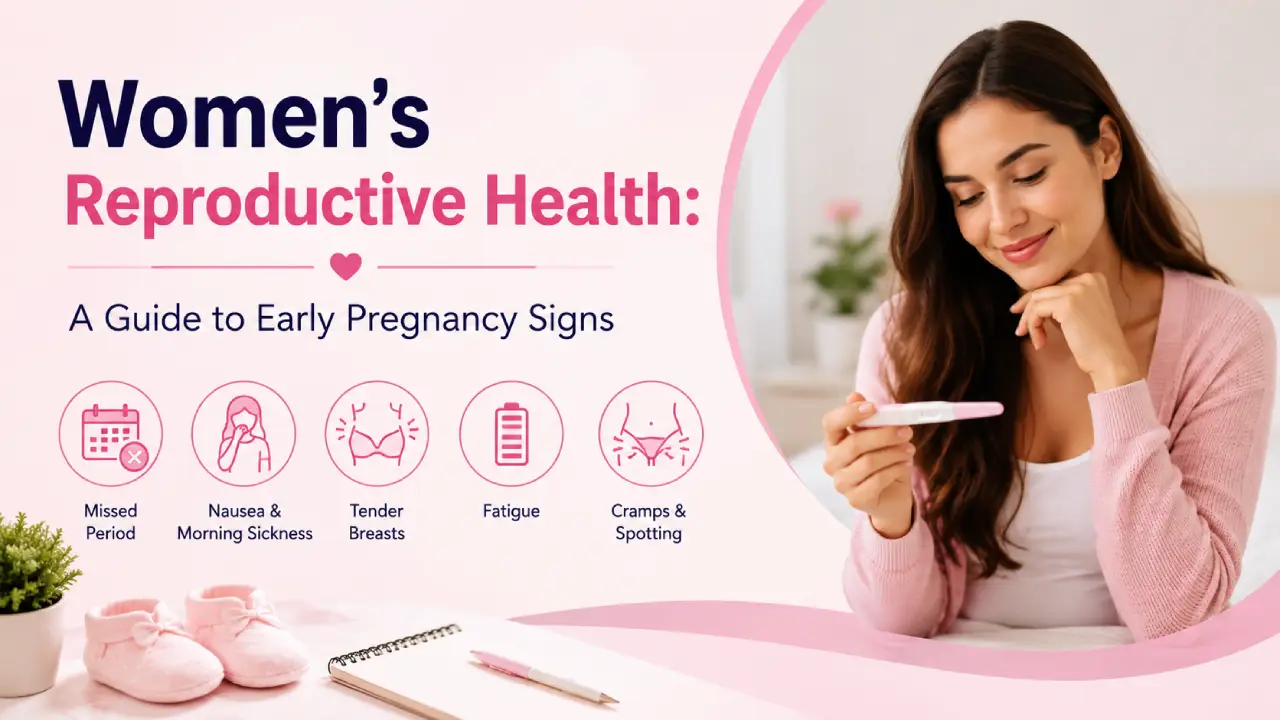
Once fertilization happens, hormones start shifting fairly quickly, and that shift is where most early symptoms come from. As part of Women’s Sexual and Reproductive Health, it’s worth knowing what those first signals tend to look like:
- A period that doesn’t show up
- Breasts that feel sore, heavy, or swollen
- Fatigue that hits harder than your usual tired
- Nausea, which despite the name “morning sickness” can strike at any hour
- Needing to pee more often
- Mild cramping
- Food suddenly smelling or tasting different than usual
- A bit of light spotting
Here’s the catch, though: not one of these symptoms proves anything by itself. Nearly all of them can just as easily be explained by stress, an oncoming period, illness, or hormones doing their own unrelated thing.
When Can Early Pregnancy Symptoms Start?
There’s no universal start date. After ovulation, if fertilization occurs, implantation in the uterine lining usually happens somewhere between six and twelve days later. That’s the moment hCG, the hormone pregnancy tests look for, starts climbing.
Because of that window, some people feel different within a week or so of conception. Others notice nothing until well after a missed period, and a fair number never notice much at all in the early weeks. None of this reflects whether a pregnancy is going well or poorly; it’s just how differently bodies respond.
Early Pregnancy Symptoms vs PMS
This is where most of the confusion lives, since PMS and early pregnancy borrow heavily from the same symptom list. Here’s how they typically stack up side by side:
| Symptom | PMS | Early Pregnancy |
|---|---|---|
| Breast tenderness | Common | Common |
| Fatigue | Possible | Common |
| Mood changes | Common | Possible |
| Cramping | Common | Possible |
| Missed period | No | Possible |
| Nausea | Less typical | Possible |
Given how much these two overlap, a pregnancy test still does more to settle the question than symptom-spotting ever will.
How Pregnancy Tests Help Confirm Pregnancy
Home pregnancy tests work by picking up hCG in urine. That hormone usually becomes detectable a few days after a missed period, though some of the more sensitive tests claim to catch it a touch earlier.
A few practical points worth keeping in mind:
- Test too early, before hCG has had time to build up, and you risk a false negative
- Read the instructions closely; timing and how long you wait for a result both affect accuracy
- A negative result paired with ongoing symptoms or a period that still hasn’t arrived is a reasonable cue to test again in a few days
- A positive result, or a result you’re unsure about, is worth bringing to a healthcare professional for confirmation and guidance on what comes next
Think of the test as a strong first clue rather than the entire story. Follow-up care fills in the rest.
How to Maintain Reproductive Health
Solid Reproductive Health Care for Women tends to come from small, repeated habits rather than one big effort. A few worth building into your routine:
- Keep up with regular checkups, gynecological exams included
- Get to know your own cycle well enough to notice when it shifts
- Practice safer sex
- Use a form of contraception that actually fits your life right now
- Get STI testing when it makes sense to
- Eat in a way that supports your overall health
- Stay active, even if it’s not formal exercise
- Skip tobacco and other substances that work against reproductive health
- Protect your sleep and manage stress where you can
- Reach out to a provider the moment something feels genuinely off
None of this guarantees a particular outcome, but taken together, it’s what Women’s Health and Reproductive Care looks like in practice over time.
When Should You See a Healthcare Professional?
A handful of symptoms shouldn’t sit on a to-do list until your next scheduled visit. Get medical attention promptly if you notice:
- Severe pain in the pelvis or abdomen
- Bleeding that’s unusually heavy
- Fainting or intense dizziness
- A fever alongside pelvic pain
- Discharge that’s persistent and out of the ordinary
- A positive pregnancy test combined with significant pain or bleeding
Paired with a possible pregnancy, symptoms like these can occasionally point to something more urgent, an ectopic pregnancy or infection among them, so it’s not a wait-and-see situation.
Reliable Sources for Women’s Reproductive Health Information
Not everything you find online deserves the same level of trust. When you’re digging deeper, lean toward sources such as:
- Government health websites, which generally rely on evidence-based public health data
- Established medical organizations
- Peer-reviewed women’s reproductive health journals, meaning the research has been vetted by other experts before it’s published
- Metrics like a journal’s Impact Factor or its SCImago ranking, both used to gauge how often a publication’s research gets cited and how influential it is in the field
- Licensed healthcare professionals
- Recognized women’s reproductive health clinics
Sticking to sources like these makes it much easier to separate solid, evidence-backed guidance from stories and anecdotes that may not apply to you at all.
Frequently Asked Questions about Women’s Reproductive Health
1. What are the 5 components of women’s reproductive health?
They’re usually described as menstrual health, fertility, safe pregnancy and childbirth, access to contraception, and the prevention or treatment of reproductive diseases and infections.
2. How to maintain female reproductive health?
Regular checkups, understanding your own cycle, safer sex habits, decent nutrition, staying active, and getting unusual symptoms checked out promptly all go a long way.
3. What are the 7 functions of the female reproductive system?
In broad terms: producing eggs, producing hormones, running the menstrual cycle, enabling fertilization, supporting implantation, sustaining a pregnancy, and making childbirth possible.
4. What are the 10 elements of reproductive health?
Lists vary depending on the source, but common elements include menstrual health, fertility care, safe pregnancy, safe childbirth, contraception access, STI prevention and treatment, infertility care, adolescent reproductive health, screenings for reproductive cancers, and general education around reproductive health.
5. Can you be pregnant and not have any early symptoms?
Yes, plenty of people barely notice anything in the early weeks. That’s exactly why a missed period and an actual pregnancy test carry more weight than how you feel.
6. How soon after a missed period should I take a pregnancy test?
Most home tests are reliable right as a period goes missing, but testing again a few days later can help if the first result seems off or symptoms keep going despite a negative.
7. Can stress delay a period and mimic pregnancy symptoms?
It can. Stress is well known for throwing off ovulation and delaying a period, and it can also bring on fatigue, appetite swings, or mood changes that look a lot like early pregnancy.
8. Is spotting always a sign of early pregnancy?
Not always. Light spotting sometimes happens with implantation, but it’s also linked to ovulation, hormone shifts, and other unrelated causes, so on its own it doesn’t confirm much.
Conclusion
Learning the basics of Women’s Reproductive Health doesn’t erase the uncertainty that comes with a body that’s suddenly acting differently, but it does make that uncertainty easier to navigate. Whether you’re trying to tell PMS apart from early pregnancy, figuring out when to test, or just building better long-term habits, good decisions start with solid information. When something feels persistent, confusing, or just plain concerning, a conversation with a healthcare professional remains the fastest route to a real answer.
Medical Disclaimer: The information provided in this article is for general educational purposes only and is not a substitute for professional medical advice, diagnosis, or treatment. Always consult a qualified healthcare professional about your individual health, pregnancy, or reproductive health concerns.